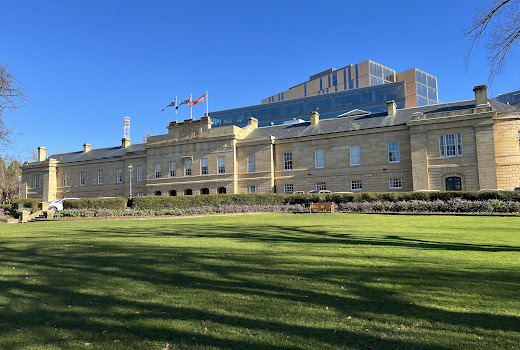
Professor Gabrielle Appleby’s Speech at Community Independents Event, Tasmanian Parliament House, 28 May 2026

Independents and Integrity
Professor Gabrielle Appleby, UNSW Law & Justice, Centre for Public Integrity
I’ve been asked to reflect on the role of independents in democracy with a particular focus on their role in securing public integrity – that lofty goal associated with government transparency and accountability for public power that can restore the seemingly ever-ebbing public trust in modern government.
Independents as a phenomenon are diverse, and so I am wary of expressing too many generalities here.
But one of the striking features of the rise of independents in the practice of modern democracy is that they appear to be responding to the desire of voters to have representation that feels closer to them – that is more responsive, more accountable, and less trapped by the opaqueness of party machinery and the strictures of party discipline. Independents can make commitments and decisions that are not veiled behind party rules. They can deliberate more openly about difficult issues.
In one sense, then, independent candidates are inherently integrity candidates because, outside of political parties, they can represent with greater integrity both their own set of beliefs and values on which they have been elected as a representative, and respond to and represent their constituents with greater integrity.
Andrew Inglis Clark understood this when he helped develop Tasmania’s Hare-Clark system. He believed democracy was healthiest when parliaments genuinely reflected the diversity of public opinion, and when political power was dispersed rather than concentrated in major parties. You can see his democratic objectives when you remember too that his push to adopt the system was part of a wider progressive agenda relating to, for example, introducing female suffrage.
The result of the Hare-Clark system is in Tasmania greater likelihood that minor parties and independents will be elected. As Inglis Clark had hoped, these candidates are able to provide a more genuinely representative parliament, one that reflects the diversity of the electorate with greater integrity rather than the aggregated votes of major parties.
As Tasmanian political scientist Richard Herr has often observed, minority government and crossbench influence are not democratic abnormalities in Tasmania — they are part of the logic of our electoral and constitutional culture. Tasmania has long had to practice negotiation, scrutiny and shared power as part of living democracy.
Accordingly, Tasmania has a long tradition of minority government, strong crossbenches, and influential independents. Although that can sometimes frustrate governments that want unfettered control, or, more generously worded, ‘stability to govern’.
The strong cross bench has been enormously valuable in other ways, however, closely related to integrity reform and practice.
We see this in two ways.
Independents and minor parties often run on explicit integrity agenda – whether that be to clean up electoral finance laws, establish an anti-corruption commission, reform RTI. They have explicit integrity policy platforms in ways that are often missing – or begrudgingly included – by the major parties.
This is closely linked to the other ways independents are integrity actors that I’ve already noted – because they are closer to the people, they also know that integrity matters to the electorate.
Secondly, we see independents pursuing an integrity agenda because they are themselves performing the role of watchdog. We hear a lot about ‘integrity agencies’ – integrity commissions, auditor-General, ombudsman. These are no doubt important institutions. But don’t forget that the primary institution within the Westminster system where is executive power is questioned, exposed and justified is the parliament. Indeed, in many jurisdictions those agencies are called officers of the parliament.
Independents often those responsible for returning parliament to its integrity function. In Parliament, they ask difficult questions. They drag government towards transparency, often against its will. They keep integrity issues on the political agenda.
We have seen that very clearly in Tasmania over the last year.
The Centre for Public Integrity’s six-month review of the second Rockliff Government last year found that important integrity reforms had advanced precisely because of Tasmania’s distinctive political dynamics — including minority government arrangements and pressure from independents in the Upper House.
The report identified progress on issues like Right to Information reform, ministerial diary disclosure, parliamentary standards and integrity legislation. But importantly, it also observed that many of these reforms emerged because governments were required to negotiate, respond to scrutiny, and operate under pressure from non-major party actors.
Because the reality is that Governments rarely volunteer to constrain their own power. And Oppositions can become cautious when they imagine themselves one day inheriting the same powers. This is the curse of the cartel politics that inflicts a two-party system.
Independents and other crossbenchers disrupt this cosy cartel. They are therefore often essential to the functioning of healthy democracy.
All of this is to that independents need to be acknowledged, and protected, within our democratic system. We should be very conscious of and wary about efforts to punish or marginalise them institutionally.
This is not a theoretical concern. We see it here and across the country in the design of electoral laws, electoral finance regimes, and parliamentary staffing and resourcing allocations.
In Tasmania, there was a blatant attempt to do so in the late 1990s. The 1998 reduction in the size of both Houses of Parliament (HA 35 to 25, LC 19 to 15), was a bipartisan agreement between the Liberal Party and the Labor Party, and while it was framed as a cost-saving reform, but it was a thinly veiled attempt to make it significantly more difficult for independents and minor parties to get elected by increasing the quota of votes needed for a seat. In 2022, the House of Assembly was returned to 35 seats, but the Legislative Council remains at its reduced number of 15 seats.
It is no accident that the constitutional challenges to the Victorian and now Commonwealth electoral funding laws have come from independent candidates – because these laws were passed with major party support, and appear designed to entrench major party advantage. Indeed, the High Court has confirmed that the Victorian laws did just that. The Commonwealth laws remain under challenge on similar grounds. The recent push by some of the so-called ‘Teal independents’ at the federal level has been largely explained on the financial advantages of party status under the federal regime.
In Tasmania, the political finance regime has high disclosure thresholds and the absence of donation caps. The public funding regime applies only to House of Assembly elections, and the expenditure caps only to the Legislative Council. This still allows major parties to leverage the advantages that come with permanent fundraising structures, party branding, established donor networks and institutional staffing.
There are also ongoing concerns about resourcing and staffing allocations. Such allocations are done, inexplicably, by the Executive Government, which has an incentive to starve independents and minor parties of the resourcing and staff to ask the questions and get on top of the material to perform their scrutiny role effectively.
If voters choose independents in growing numbers, democratic systems should adapt to accommodate that reality — not try to force politics back into a two-party mould that many voters are consciously moving away from.
In Tasmania, in particular, we know that Independents are not a temporary disruption. They are part of an ongoing evolution in our practice of democracy. Voters increasingly expect representation that is participatory, accountable and locally grounded. They want integrity taken seriously.
And while independents can sometimes produce political complexity, it has also produced important democratic benefits.